So, you’re new to the workforce! Deciphering your paychecks can be a bit overwhelming, right? Don’t worry; we’re here to help with this Payroll 101 guide.
This guide will break down payroll basics so you can confidently understand your paycheck and make informed financial decisions. Let’s dive in!
SAMPLE PAYCHECK
First, let’s start with a sample paycheck and look at how it goes from your total earnings to your take-home amount.
Need to know what all of the terms mean? No worries! We have a glossary up next with easy-to-understand definitions.
Example:
- Gross (total) Pay: $3,000
- Pre-Tax Deductions:
- Health Insurance: $100
- 401(k): $200
After taking out the pre-tax (nontaxable) deductions, this leaves you with taxable income. Since $300 of your income (health insurance and 401k) is non-taxable, the government can now only tax $2,700 of your paycheck.
- Taxes:
- Federal Income Tax: $400 (estimated based on the IRS standard deduction)
- State Income Tax: $150 (estimated based on a sample state tax rate of 5%)
- FICA – Social Security Tax: $186 (6.2% of $3,000)
- FICA – Medicare Tax: $43 (1.45% of $3,000)
- Post-Tax Deductions:
- Holiday savings account: $50
- Wage garnishment: $50
- Net (take-home) Pay: $3,000 – $100 – $200 – $400 – $150 – $186 – $43 – $50 – $50 = $1,821
As you can see, a significant portion of your gross pay may be deducted for various reasons, resulting in a lower net pay. Understanding these deductions can help you manage your finances more effectively.
GLOSSARY
Benefits are extra perks or advantages your employer offers in addition to your salary, such as health insurance, retirement plans, and flexible spending accounts. Learn about Nextep’s benefit offerings here.
These are amounts taken out of your paycheck to pay for things like taxes, insurance, garnishments, and retirement savings.
This is when your paycheck is automatically deposited into your bank account(s) on payday. Direct deposit dramatically reduces the occurrence of delayed, lost, or stolen checks. You will need your 9-digit routing number (also called “ABA number”) and the account number to enroll. Employees can establish multiple accounts and have a set amount or percentage of the paycheck automatically deposited into specified accounts. For example, the employee can deposit 10% of each paycheck into a personal savings account and the remainder to a checking account. Please note that banks usually need between 3-7 days to approve direct deposit changes.
In this situation, we’re referring to an employee exempt from overtime pay (see “tax-exempt” below for W-4 exemption). The Fair Labor Standards Act (FLSA) exempts certain employees from overtime pay. These employees are paid a fixed salary and perform their duties regardless of the number of hours they work. Exempt employees typically have a specific job title (e.g., executive, administrative, professional, computer, or outside sales) and must meet specific salary and duties requirements.
Fair Labor Standards Act (FLSA)
The Fair Labor Standards Act (FLSA) is a federal law that establishes minimum wage, overtime pay, recordkeeping, and youth employment standards affecting employees in the private sector and Federal, State, and local governments.
Flexible Spending Account
These are employee benefit plans that allow employees to set aside pre-tax money to spend on specified health or childcare expenses. Nextep offers several pre-tax savings account options, including FSA, HSA, DCA, LPFSA, and Parking & Transit FSA.
FICA Tax
FICA tax is made up of two parts: Social Security tax (6.2% of your earnings up to a specific limit) and Medicare tax (1.45% of all your earnings). Employers match your FICA withholdings up to a limit. These funds go toward government programs that help people when they retire or need medical care.
This is a tax that the federal government takes out of your paycheck. The amount of federal income tax withheld from your paycheck depends on your income, filing status, and the number of withholding allowances you claim on your W-4 form.
Garnishment
This legal process allows a creditor to collect a debt by taking money directly from your paycheck. If you have a court judgment against you, a creditor can garnish your wages to satisfy the debt. Payroll pros are required by law to comply with the garnishment order.
This is the total amount of money you earn before any taxes or deductions are taken out. If you work 40 hours at a rate of $20 per hour, for example, your gross pay would be $800.
Also referred to as “non-exempt,” this refers to an employee who is paid based on the number of hours they work, as opposed to a set salary. Since these employees are not exempt from overtime pay, they must be paid at time and one half for each hour worked over 40 in a workweek.
When you start a new job, your employer will ask you to complete an I-9 form and provide documentation proving your identity and eligibility to work in the U.S.
Some cities and counties have local income taxes, while others do not. If applicable, the amount of local income tax withheld from your paycheck depends on your income and the local tax rate.
Medicare Tax
Part of the FICA withholdings, this tax goes towards Medicare, a government program that helps pay for medical expenses. Medicare tax is 1.45% of all your earnings. For high earners, the Medicare tax rate increases by 0.9% (2.3% total) once they’ve earned a certain amount during the calendar year.
This is the lowest hourly wage an employer can pay an employee. As of publication date, the federal minimum wage in the United States is $7.25 per hour, but many states and cities have higher minimum wages. If federal and state regulations differ, the employer must use the one that benefits the employee the most.
Also referred to as “take-home pay,” This is the amount of money you actually take home after all the taxes and deductions have been taken out. If your gross pay is $1,000 and your total deductions are $200, your net pay would be $800.
This is extra pay you earn for working more than 40 hours in a workweek. If your regular hourly rate is $20 and you work 10 hours of overtime, you would earn an additional $300 in overtime pay (10 hours x $20 x 1.5)
Paycard
This is a prepaid debit card that you can use to access your paycheck. It is an alternative to direct deposit for people who do not have a bank account. Your employer can load your paycheck onto a paycard, which you can then use to make purchases or withdraw cash.
Payday
This is the day of the week or month you receive your paycheck. Your payday might be every week, biweekly, semimonthly, or the last day of the month, but it must be on a set and consistent schedule.
Payroll Period
This is the length of time covered by a single paycheck. Your payroll period is one week if you are paid weekly. If you are paid biweekly, your payroll period is two weeks. If you are paid monthly, your payroll period is one month.
Pay Stub
Your pay stub brings all of these concepts together to show your what your earnings are for the pay period. You’ll see gross pay, pre and post-tax deductions, tax withholdings, paid time off used, and your net pay. Your pay stub usually also includes year-to-date earning information, which makes this document useful when applying for loans or credit or recalculating if you are withholding enough taxes. Nextep clients can find pay stubs on their Elevate by Nextep™ app by clicking Pay, the date they wish to review, and View.
Preauthorization
When you make changes to your direct deposit accounts for paychecks, your bank will preauthorize the changes to ensure your money will be allocated correctly before payday occurs. You may see this show up as a one-cent charge on your account, purely for testing purposes on the bank’s part. Please note that when you make changes or set up a new direct deposit account, your bank can take up to 3-7 days to fully preauthorize your changes. Until then, your paycheck will default to your existing deposit methods.
Pre-Tax Benefits
These benefits are paid for with pre-tax dollars, reducing your taxable income. Health insurance, dental insurance, vision insurance, life insurance, flexible spending accounts (FSAs), traditional retirement plan contributions (401(k), IRA), and certain other benefits may be deducted pre-tax.
Post-Tax Benefits
These benefits are paid for after your dollars have been taxed, which means they do not reduce your taxable income. They can include stock options, employee discounts, gym memberships, holiday savings accounts, and Roth 401(k) deductions.
You may also see this referred to as time off, vacation, sick pay, personal time, or others. Paid time off (PTO) is an allotment of time off from work in which your employer still pays your regular rate of pay. Please note that PTO hours do not contribute to overtime since they are not hours worked. For example, if you worked 36 hours and took 8 hours PTO, all 44 hours would be at your regular rate of pay, since your regular hours worked did not exceed 40 in a workweek.
Regular Hours
These are the standard number of hours you are expected to work each week. For example, a typical workweek for a full-time employee is 40 hours.
The regular rate of pay is the money paid for regular hours worked in a workweek, and the rate of pay that overtime pay is calculated from. For example, it does not include bonuses, expense reimbursements, holiday pay, paid time off, court time, or discounts.
Salary
This is a fixed amount of money paid to an employee for their work, typically on a monthly or yearly basis. See also “exempt.”
Social Security Tax
Part of the FICA withholdings, this tax goes towards Social Security, a government program that provides retirement benefits. You may see this on your paystub as “FICA – OASDI.” Social Security tax is 6.2% of your earnings up to a specific limit, and is matched by your employer.
This is a tax that your state government takes out of your paycheck based on how much money you make. The amount of state income tax withheld from your paycheck depends on your income and the state tax rate. See your state’s Department of Labor webpage for specific state tax rates.
Tax Exempt
You may claim exemption from tax withholding if you meet specific conditions laid out by the IRS, such as having no federal income tax liability. If you claim exemption, you will have no income tax withheld from your paycheck and may owe taxes and penalties when you file your tax return. An exempt W-4 is only valid during the calendar year it was provided, so you will be required by the IRS to complete a new exempt W-4 and return it to Nextep by February 15 each year. Failure to complete a new W-4 will result in a tax status of single with 0 allowances. See the IRS website for more information.
This is a record of the hours you work, used to calculate your pay. You might use a biometric scanner, time clock, time tracking app, or other means laid out by your employer to record your work hours. Or if you work on a salary basis, your employer may auto-tally your hours for you.
W-2 Form
This form shows how much you earned and how much tax was taken out of your paycheck during the previous year. You will receive a W-2 form from your employer by January 31st of the following year. You will need to use this form to file your federal and state income taxes. Please note that the amount of tax withheld on your W-2 is based on the W-4 form you submitted, so your employer is not liable for any over or under-withholdings. See our FAQ for more W-2 questions and answers.
If your company is a Nextep client, you’ll see the company name on your W-2 appear as “Nextep.” Don’t worry – this doesn’t change the terms of your employment or the company you work for. It simply reflects Nextep’s responsibility for handling payroll, benefits, workers’ comp, and HR needs for your company, for which we are the employer of record.
W-4 Form
When you start a new job, you will be asked to fill out a W-4 form to tell your employer how much federal income tax to withhold from your paycheck. The number of withholding allowances you claim on this form will affect the amount of federal income tax withheld from your paycheck.
Withholding Allowance
Claim this number on your W-4 form to determine how much federal income tax is withheld from your paycheck. Each withholding allowance you claim reduces the amount of federal income tax withheld from your paycheck. The number of withholding allowances you should claim depends on your marital status, the number of dependents you have, and other factors, but mainly refers to how much tax you want withheld from each paycheck. A married person with four children, for example, doesn’t necessarily have to claim “married with 4” on their W-4 form.
It’s a personal choice that depends on your family’s tax liabilities. The IRS offers a handy tax withholding estimator to help you decide what to claim on your W-4. While getting an exact number is complex, the IRS’s tax estimator can help ensure you don’t have too much or too little federal income tax withheld. Please note that your employer and Nextep cannot give you tax advice.
You might also be interested in…
2025 state law updates

2025 will bring several state law updates, Get a state-by-state rundown here.
DOWNLOAD: 2025 STATE LAW UPDATES
2025 Minimum Wage Updates

Are you ready for 2025 changed to state and local minimum wages? Get your list here.
2025 Tax, FSA, and Retirement updates

Keep it handy! Download a printable flyer with 2025 tax, FSA, and retirement updates.
2025 BANK HOLIDAYS
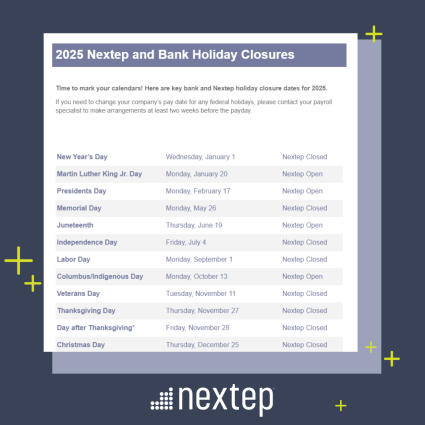
Need a printable copy of the 2025 bank holidays list? Here it is! Download, print, and refer to it at your convenience.
2025 SUTA Wage Bases

We’ve compiled a comprehensive list of 2025 SUTA (State Unemployment Tax Act) wage bases. Find your state in the table and discover the applicable wage base for the upcoming year.