Many new or updated state laws will go into effect in the coming months. Our compliance experts have summarized state law updates in your state that may impact your business.
As a reminder, in cases where state and federal laws may differ, employers must use the one that benefits the employee the most.
Need a clickable index and quick reference? Click here for a handy downloadable version of these updates:
DOWNLOAD: 2025 STATE LAW UPDATES
FEDERAL
Minimum Wage for Contractors
Effective January 1, 2025, the minimum wage for federal contractors increases from $17.20 per hour to $17.75 per hour under an annual inflation adjustment required by executive order. Visit the DOL Website.
FEDERAL
Employers’ Use of AI in the Workplace
Main Aspects:
Responsible AI Implementation: The DOL emphasizes that employers must prioritize employee rights and protections when using AI in the workplace. Existing labor and employment laws still apply, even when AI is involved.
Human Oversight is Crucial: The guidance stresses the need for human oversight throughout the AI lifecycle – from development and training to deployment and decision-making. This ensures fairness, and accountability, and mitigates potential risks.
Transparency and Employee Engagement: Employers should be transparent with employees about how AI is being used, what data is collected, and how it impacts decision-making. Engaging employees throughout the process is key to building trust and ensuring equitable outcomes.
Key Points and Facts:
- The DOL guidance responds to President Biden’s executive order on responsible AI use.
- The guidance provides best practices for both AI developers and employers. The DOL’s focus is on worker well-being and ensuring AI doesn’t undermine existing labor rights.
Important to Consider:
“Employers should ensure meaningful human oversight’ over any decisions supported or influenced by AI…” This highlights the importance of maintaining human control and accountability, even as AI becomes more prevalent in the workplace.
“AI ‘should assist, complement, and enable workers, and improve job quality’. This quote emphasizes the desired positive impact of AI implementation and cautions against using AI to the detriment of workers.
“Employers should ensure that the AI systems in use are not inadvertently collecting employee data without the employee’s voluntary and informed consent…” This underscores the importance of data privacy and transparency in AI applications.
Recommended Actions for Employers:
- Review the DOL guidance in detail and incorporate the best practices into internal policies and procedures.
- Conduct regular audits of AI systems to identify and mitigate potential risks to employee rights.
- Provide clear notice to employees about how AI is used, what data is collected, and how it may impact their employment.
- Offer training and support to employees on how to effectively work with AI systems.
Conclusion:
The DOL guidance provides a framework for responsible AI use in the workplace. By prioritizing human oversight, transparency, and employee engagement, employers can leverage AI’s potential while safeguarding worker well-being and upholding legal obligations.
Alaska
AK: State Increases Salary Threshold
Effective 01/01/2025
Effective January 1, 2025, the minimum weekly salary for overtime-exempt executive, administrative, or professional employees in Alaska increases from $938.40 to $952.80 under an annual inflation adjustment required by the state statute.
AK: State Amends Workers Compensation Re-Employment Benefits Eligibility
Effective 01/01/2025
Effective January 1, 2025, an employee may be eligible for workers’ compensation re-employment benefits if they are unable to return to work for 25 consecutive days. Previously, employees had to be out of work for 45 consecutive days.
California
CA: State Prohibits Digital Replica Usage in Employment Agreements
Effective 01/01/2025
Effective January 1, 2025, state law makes any provision in an agreement for the performance of personal or professional services unenforceable if the provision:
- Allows the creation and use of a digital replica of an individual’s voice or likeness in place of work the individual would otherwise have performed in person;
- Does not include a reasonably specific description of the intended uses of the digital replica, unless the uses are consistent with the terms of the contract for the performance of the services and the fundamental character of the photography or soundtrack as recorded or performed; and
- The individual engaged was not represented by:
- Legal counsel who negotiated on the individual’s behalf for licensing their digital replica rights, and the commercial terms are stated clearly and conspicuously in a contract or other writing signed or initialed by the individual; or
- A labor union representing workers who do the proposed work, and the terms of their collective bargaining agreement expressly addresses uses of digital replicas.
Digital replica means a computer-generated, highly realistic electronic representation that is readily identifiable as the voice or visual likeness of an individual that is embodied in a sound recording, image, audiovisual work, or transmission in which the actual individual did not actually perform or appear.
The law applies only to the performance of personal or professional services on or after January 1, 2025.
CA: Allows Alternate Whistleblower Notice to Be Posted
Effective 01/01/2025
Effective January 1, 2025, California employers that display the model list developed by the labor commissioner of employees’ whistleblower rights and responsibilities are deemed to be in compliance with the whistleblower law posting requirements.
Key implications for employers in California regarding the new whistleblower posting requirement. Here’s what it means:
- Compliance Requirement: Employers must display the model whistleblower poster in a prominent location, ensuring employees are aware of their rights to report misconduct.
- Legal Protection: The law emphasizes the protection of whistleblowers against retaliation, reinforcing the need for a supportive workplace culture.
- Risk Management: Non-compliance could lead to legal issues, including fines or penalties, making it essential for employers to update their workplace postings.
- Employee Awareness: The posting serves to inform employees about how to report concerns, potentially fostering greater transparency and accountability in the workplace.
- Implementation Steps: Employers should review the model poster, ensure it is properly displayed, and communicate its significance to their workforce.
Resources:
CA: State Requires Employers to Disclose Findings of Any Voluntary Child Labor Audits
Effective 01/01/2025
California Governor Gavin Newsom signed Assembly Bill (AB) 3234 into law, imposing more transparency requirements for employers that audit their child labor practices. The bill will take effect on January 1, 2025.
Under AB 3234, any employer that has voluntarily subjected its business to a “social compliance audit” to determine in whole or in part if child labor is involved in the employer’s operations or practices, must post a link on its website to a report detailing the findings of the audit. AB 3234 defines “social compliance audit” as a voluntary, nongovernmental inspection or assessment of an employer’s operations and practices to verify that it complies with state and federal labor laws, including health and safety regulations regarding child labor.
AB 3234 provides that the following information must be included within the compliance report:
- The year, month, day, and time the audit was conducted, and whether the audit was conducted during a day shift or night shift;
- Whether the employer engages in or supports the use of child labor;
- A copy of the employer’s written policies and procedures regarding child employees;
- Whether the employer exposes children to any workplace situations that are hazardous or unsafe to their physical and mental health and development;
- Whether children work within or outside regular school hours, or during night hours, for the employer; and
- A statement that the auditing company is not a government agency and is not authorized to verify compliance with state and federal labor laws or other health and safety regulations.
Given this upcoming change in the law, legal and compliance teams should assess whether their companies are subject to the AB 3234 disclosure requirements.
CA: State Law Restricts Driver’s License Requirements in Job Postings
Effective 01/01/2025
Senate Bill (SB) 1100 was signed into law making it an unlawful employment practice to include statements about the need for a driver’s license in job advertisements, postings, applications, and similar employment material. In California, driver’s licenses have increasingly become a condition of employment. The law addresses discrimination against individuals without driver’s licenses by eliminating this requirement as a condition of employment unless certain requirements are met.
Under the law, an employer may not include a statement that an applicant must have a driver’s license unless the following conditions are satisfied:
- The employer reasonably expects driving to be one of the job functions of the position.
- The employer reasonably believes that using an alternative form of transportation would not be comparable in travel time or cost to the employer.
An “alternative form of transportation” can include, but is not limited to:
- Ride-hailing services.
- Taxis.
- Carpooling.
- Bicycling.
- Walking.
CA: State Minimum Wage and Salary Threshold Increase
Effective 01/01/2025
California will see another increase to its minimum wage on January 1, 2025. The minimum wage in California will increase from $16.00 per hour to $16.50 per hour on January 1, 2025. This increase applies to all employers, regardless of size.
Additionally, the minimum salary for full-time exempt employees will increase from $66,560 annually to $68,640 annually/or $1,320.00 per week on January 1, 2025.
However, employers should be aware that numerous cities and industries across the state have separate minimum wages, which are typically higher than the state minimum wage.
CA: State Amends Hairstyle Discrimination
Effective 01/01/2025
Effective January 1, 2025, the definition of race under the California Fair Employment and Housing Act (FEHA) and the Unruh Civil Rights Act is amended to apply to traits associated with race, including hair texture and protective hairstyles. The prior definition covered traits “historically associated” with race.
CA: State Amends Jury, Court, and Victim Time Off Provisions
Effective 01/01/2025
The governor signed Assembly Bill (AB) 2499, expanding the list of crimes for which employees can take time off and allowing employees to take protected time off to assist family members who are victims of specified crimes. The new law also permits the use of state-paid sick leave for these purposes.
Under AB 2499, these protections remain in place, but broaden the definition of “victims” to include a victim of a “qualifying act of violence,” which means any of the following, regardless of whether anyone is arrested for, prosecuted for, or convicted of committing any crime:
- Domestic violence
- Sexual assault
- Stalking
- An act, conduct, or pattern of conduct that includes:
- An individual causes bodily injury or death to another
- An individual exhibits, draws, brandishes, or uses a firearm or other dangerous weapon, with respect to another
- An individual uses or makes a reasonably perceived or actual threat of use of force against another to cause physical injury or death.
This law removes the threshold of 25 or more employees from the provisions for victims of crime or abuse, and now requires all employers with at least one employee to comply, except as specified.
Employers with five or more employees must not discriminate or retaliate against an employee who is a victim or has a family member who is a victim from taking time off from work for additional reasons beyond obtaining relief or attempting to obtain relief (temporary restraining order, restraining order, or other injunctive relief) to ensure the health, safety, or welfare of the victim or family member of the victim.
Under the bill employees are permitted to use vacation, personal leave, paid sick leave, or compensatory time off that is available unless otherwise provided in a collective bargaining agreement.
Finally, under the law employers will be required to provide written notice of their rights established under this bill to new hires, to all employees annually, at any time upon request, and any time the employer becomes newly aware that an employee or an employee’s family member is a victim.
CA: State Amends Paid Family Leave Requirements & Benefit Increase
Effective 01/01/2025
Under amendments to the paid family leave (PFL) law, employers can no longer require that employees use vacation or paid time off (PTO) before receiving PFL benefits.
Also effective January 1, 2025, benefit amounts increase to 70 percent (from 60 percent) of average weekly earnings, or 90 percent (from 70 percent) for employees earning under a certain income level, for employees receiving paid family leave benefits through the Family Temporary Disability Insurance (FTDI) program.
CA: State Prohibits Intersectional Discrimination
Effective 01/01/2025
The California Fair Employment and Housing Act (FEHA) is amended to prohibit discrimination and harassment based on any combination of two or more protected characteristics. The amendments also prohibit discrimination based on a perception that a person:
- Has any particular combination of protected characteristics; or
- Is associated with a person who has, or is perceived to have, any combination of protected characteristics.
CA: State Amends Protections for Crime Victims
Effective 01/01/2025
Amendments broadening protections for crime victims affect multiple employment laws.
Amendments to the Healthy Workplaces, Healthy Families Act (HWHFA) expand the qualifying reasons for safe leave and the definition of a victim. The HWHFA amendments also affect the kin care leave law, which incorporates qualifying reasons from the HWHFA.
Amendments to the domestic violence and crime victim leave law impact the following provisions:
- Qualifying reasons for leave;
- Duration of leave;
- Covered family members;
- Benefits during leave;
- Confidentiality requirements; and
- Employer notice requirements.
Under both the domestic violence and crime victim leave law and the antidiscrimination law, employers must provide safety-related reasonable accommodations upon request to employees who are victims of qualifying acts of violence, or whose family members are victims.
Also, amendments to the law requiring leave for crime victims to attend judicial proceedings modify the definition of a victim and the law’s interaction with other types of available leave.
CA: State Sunsets Independent Contractor Exemptions for Certain Workers
Effective 01/01/2025
The exemptions from California’s statutory ‘ABC test’ for independent contractor classification no longer apply to:
- Newspaper distributors working under contract with a newspaper publisher;
- Newspaper carriers working under contract with either a newspaper publisher or a newspaper distributor;
- Licensed manicurists; and
- Certain subcontractors providing construction trucking services.
CA: State Amends Workplace Violence Restraining Order Law
Effective 01/01/2025
The significant amendments to California’s Workplace Violence Restraining Order (WVRO) law, effective January 1, 2025, under Senate Bill 428, expand protections for employees and give employers broader tools to ensure workplace safety. Here are the notable changes:
- Broader Scope of Protection
- Harassment Added to Criteria: Previously, WVROs could only be sought for violence or credible threats of violence. Now, employers can also request restraining orders for harassment.
- Definition of Harassment: A knowing and willful course of conduct that seriously alarms, annoys, or harasses a person, serving no legitimate purpose, and causing substantial emotional distress
- Easier Access for Employers
- Employers can act proactively to protect employees without waiting for violence or threats of violence to occur. This provides preventive measures in cases of stalking, obsessive behavior, or harassment before they escalate.
- Employee Anonymity
- Employees can remain anonymous when the employer petitions for a WVRO. This change protects employees’ privacy and reduces fear of retaliation
- Limitations on Restraining Orders
- Restraining orders cannot be issued for conduct protected under the Constitution, the National Labor Relations Act, or other statutory provisions. This ensures the law is not misused to infringe on free speech or lawful union activities
- Enhanced Employer Accountability
- Employers are encouraged to address inappropriate behaviors early by using the new harassment provision, ensuring a safer and more respectful workplace
These amendments aim to create a more comprehensive framework for addressing workplace harassment and violence, allowing employers to act decisively to protect their workforce.
To read more on the Workplace law, please visit the state’s website,
CA: State Amends Details Under the Consumer Privacy Act
Effective 01/01/2025
The California Consumer Privacy Act (CCPA) is amended to clarify the definition of personal information, including the formats in which it can exist.
AB 1008 clarifies the scope of personal information. The amended definition clarifies that personal information can exist in various formats, including but not limited to:
- Physical formats, including paper documents, printed images, vinyl records, or videotapes;
- Digital formats, including text, image, audio, or video files; and
Abstract digital formats, including compressed or encrypted files, metadata, or artificial intelligence systems are capable of outputting personal information.
Expansion of Right to Opt Out
Effective January 1, 2025, the CCPA is amended to require successor businesses to comply with consumer opt-out directions.
Under the CCPA, consumers have the right to direct a business not to sell or share their personal information to third parties, referred to as the right to opt out of sale or sharing.
AB 1824 requires a business to which another business transfers consumer personal information as an asset, as part of a merger, acquisition, bankruptcy, or other transaction, to comply with a consumer’s original opt-out direction to the transferring business.
Monetary Threshold Adjustments
Beginning January 1, 2025, and occurring January 1 of any odd-numbered year thereafter, AB 3286 authorizes the California Privacy Protection Agency (Agency) to adjust certain monetary thresholds under the CCPA to reflect increases in the Consumer Price Index.
One of the monetary thresholds subject to adjustment is the annual gross revenues threshold used to determine whether a business is covered by the CCPA.
The Agency must post the adjusted monetary thresholds on its website by January 15 of the year in which the adjustment becomes effective.
Colorado
CO: State Increases Salary Threshold
Effective 01/01/2025
The minimum salary for executive / supervisory employees, administrative employees, professional employees, and other employees exempt from the minimum wage and overtime provisions of the Colorado Overtime and Minimum Pay Standards (COMPS) Order increases from $1,057.69 per week to $1,086.25 per week.
The minimum hourly wage for computer employees increases from $33.17 to $34.07, and the minimum annual salary for highly compensated employees increases from $123,750 to $127,091.
Delaware
DE: Paid Family and Medical Leave Contributions Begin- REMINDER!
Effective 01/01/2025
Delaware’s Paid Family and Medical Leave (PFML) program begins requiring employer contributions on January 1, 2025, with employees able to file benefit claims starting January 1, 2026. Employers must prepare by complying with the program’s requirements depending on their workforce size:
Coverage Requirements:
- Employers with 10–24 employees: Required to offer parental leave only.
- Employers with 25+ employees: Must provide parental, medical, and family caregiving leave.
- Employers with fewer than 10 employees: Exempt but may opt-in voluntarily.
Contribution Details:
- The total contribution rate is 0.8% of wages, shared between employers and employees. Employers can pass up to 50% of the cost to employees via payroll deductions.
- For employees earning $50,000 annually, the cost for parental leave only is approximately $160 per year, while full coverage costs $400 per year.
Leave Benefits:
Employees can receive up to 80% of wages (up to $900 per week) for:
- Parental leave: Up to 12 weeks annually.
- Family caregiving or medical leave: Up to 6 weeks every 24 months.
- Military exigency leave: Up to 6 weeks every 24 months.
Employees are limited to 12 weeks of combined leave in a 12-month period.
Employer Steps:
- Registration: Covered employers must create an account on Delaware’s PFML portal and ensure compliance by January 2025. Clients are responsible for registering in the portal and linking Nextep to their account. We cannot create on the clients behalf.
- Private Plans: Employers may apply for an exemption by offering an approved private plan instead of participating in the state plan. The deadline to submit this application is December 1, 2024. Any client under Nextep’s current plan will not be eligible for exemptions.
- Payroll Adjustments: Employers should work with payroll providers to handle deductions and contributions.
- Employee Notice: Inform employees about their rights under PFML, and ensure proper postings are displayed in the workplace. You can find the notice here.
Additional guidance can be found on Delaware’s Department of Labor website or by reaching out to the HR team at Nextep.
Illinois
IL: State Enacts Pay Transparency Law
Effective 01/01/2025
Illinois employers will soon be required to reveal salary information in job postings, thanks to a new law that will take effect on January 1. Amendments to the Illinois Equal Pay Act will require covered organizations to provide pay scale and benefits information in their job postings for positions that will be physically performed, at least in part, in Illinois, or positions that will be physically performed outside of Illinois if the employee reports to a supervisor, office, or other work site in the state.
Here’s a summary of the key points from the article on the new Illinois pay transparency rules:
- New Pay Transparency Law: Effective January 1, 2025, Illinois requires employers with 15 or more employees to include pay ranges in job postings.
- Pay Range Requirements: Employers must list the “minimum and maximum” salary or hourly wage in postings. The range should reflect the actual compensation the employer is willing to offer for the role.
What Impact does this have on job postings:
- Applies to all internal and external job postings for positions based in Illinois.
- The rule applies to both remote and in-person roles if the work is performed in Illinois.
Additional Requirements for Employers:
- Employers must also include a job description with the pay range.
- Employers must provide pay range information to employees upon request, even if they are not applying for the role.
Enforcement and Penalties:
- Non-compliance may result in fines and other penalties from the Illinois Department of Employment Security (IDES).
- IDES has the authority to investigate complaints regarding pay transparency violations.
Exceptions:
- The rule doesn’t apply to positions that are part of a collective bargaining agreement or where wage information is classified due to security concerns.
Next Steps for Employers:
- Employers should start reviewing their pay practices and develop a strategy for compliance.
- Ensure pay ranges are properly established and reflect the market rate for the position.
- Revise job posting templates to include required pay range information.
This new law emphasizes pay transparency and aims to address pay disparities by making salary information publicly available to job applicants.
Resources:
IL: State Expands Pay Statement Requirements
Effective 01/01/2025
The pay statement requirements are significantly expanded. A pay statement must be an itemized statement that shows an employee’s:
- Hours worked
- Overtime hours worked
- Rate(s) of pay
- Overtime pay
- Gross wages earned
- Deductions from the employee’s wages
- Yearly total of wages to date; and
- Yearly total of deductions to date
Additional amendments add significant requirements regarding recordkeeping, employee requests for additional pay statements, and penalties.
Nextep will ensure compliance with these measures.
IL: HRA Statute of Limitations Extended, Prohibited Discrimination Based on Reproductive Health Decisions
Effective 01/01/2025
The statute of limitations under the Illinois Human Rights Act (IHRA) is extended from 300 days to two years.
The Illinois Human Rights Act (IHRA) is also amended to prohibit discrimination based on a person’s reproductive health decisions.
Reproductive health decisions means a person’s decisions regarding the use of:
- Contraception, fertility, or sterilization care;
- Assisted reproductive technologies;
- Miscarriage management care;
- Healthcare related to the continuation or termination of pregnancy; or
- Prenatal, intranatal or postnatal care.
IL: Protections Against Captive Audience Meetings
Effective 01/01/2025
Illinois’s Worker Freedom of Speech Act prohibits employers from discharging, disciplining, or otherwise penalizing (or threatening such actions) an employee or taking any adverse employment action against an employee for refusing to attend or take part in an employer-sponsored meeting or to receive any communication intended to convey the employer’s opinions about political matters.
The law defines political matters to include anything related to the decision to join or support a labor organization.
Employers are also prohibited from offering positive incentives (such as compensation and other rewards) to employees to induce attendance at such meetings.
Employers have an affirmative duty to post and keep a notice about the law’s protections where such notices are customarily posted within 30 days after the effective date.
IL: State Repeals Child Labor Law
Effective 01/01/2025
The Illinois Child Labor Law, 820 ILCS 205/1 et seq., is repealed and replaced with the Child Labor Law of 2024, which establishes requirements for minors under the age of 16 involving:
- Prohibited Occupations
- Hours of work
- Break periods, and
- Employment certificate/work permits
In addition, employers must ensure that all minors are supervised by an adult 21 years of age or older, on site, at all times while the minor is working.
To read more about Illinois Child Labor Law Compliance, please visit the website or reach out to the Nextep HR Team.
IL: State Amends the Personnel Record Review Act
Effective 01/01/2025
Amendments to the Illinois Personnel Record Review Act (the Act) expand the categories of documents to which employees may request access and change the procedures for submitting and responding to such requests.
Every employee has the right to inspect, copy, and receive copies of their personnel records upon written request to their employer. Written requests include any electronic communications, such as email or text messages.
In addition to personnel documents used to determine an employee’s qualifications for employment, promotion, transfer, additional compensation, discharge, or other disciplinary action, an employee has the right to request access to:
- Personnel documents used to determine their qualifications for benefits and any compensation;
- Any employment-related agreements that the employer considers legally binding on the employee;
- Any employee handbooks that the employer made available to the employee or that the employee acknowledged receiving; and
- Any written employer policies or procedures that the employer contends the employee was subject to and that concern qualifications for employment, promotion, transfer, compensation, benefits, discharge, or other disciplinary action.
An employee does not have the right to inspect certain categories of documents under the Act, including an employer’s trade secrets, client lists, sales projections, and financial data.
An employee’s written request must:
- Identify the personnel records they are requesting or if they are requesting all records they may request under the Act;
- Specify if they are requesting to inspect, copy, or receive copies of the records;
- Specify whether records should be provided in hardcopy or in a reasonable and commercially available electronic format;
- Specify whether inspection, copying, or receipt of copies will be performed by that employee’s representative, including family members, lawyers, union stewards, other union officials, or translators; and
- If the records being requested include medical information and medical records, include a signed waiver to release medical information and medical records to that employee’s specific representative.
An employer must comply with the employee’s request within seven working days after receipt of the request. An employer that does not maintain records in a requested category may respond in writing to notify an employee of that fact, but must permit inspection, copying, and receipt of copies of any other requested categories of records that it does maintain. If an employer maintains the records in a manner and fashion that the employee can already access, the employer may instead provide the employee with instructions on how to access that information.
To find out more about the Personnel Record Act, please reach out to the Nextep HR Team.
IL: State Amends Secure Choice Savings Program
Effective 01/01/2025
The Illinois Secure Choice Savings Program is amended, no longer requiring, but now permitting, employers to designate an open enrollment period.
Employers are also required to allow employees who initially opted out to enroll in the Program at any time, in lieu of only doing so during the designated open enrollment period.
Clients that utilize Nextep’s 401k plan do not need to participate in the Secure Choice Savings Program.
To review more on the Secure Choice Savings Program, visit the website or reach out to Nextep’s HR Team.
IL: State Extends Military Leave Protections
Effective 01/01/2025
Members of the US Space Force are now covered under the Illinois Service Member Employment and Reemployment Rights Act (ISERRA).
ISERRA covers employees in military service, which is defined to include service in the Armed Forces of the United States. HB 5640 expands references in Illinois law to the armed forces of the United States to include the United States Space Force.
IL: State Prohibits Discrimination Based on Family Responsibility
Effective 01/01/2025
The IHRA is amended to prohibit discrimination based on family responsibilities.
Family responsibilities means an employee’s actual or perceived provision of personal care to a family member.
Personal care means activities to ensure that a covered family member’s basic medical, hygiene, nutritional, or safety needs are met, or to provide transportation to medical appointments, for a covered family member who is unable to meet those needs themself. Personal care also means being physically present to provide emotional support to a covered family member with a serious health condition who is receiving inpatient or home care.
A covered family member includes an employee’s:
- Child or stepchild;
- Spouse or domestic partner;
- Sibling;
- Parent;
- Stepparent;
- Parent-in-law;
- Grandchild; and
- Grandparent.
Employers are not required to make accommodations to their reasonable workplace rules or policies based on an employee’s family responsibilities, as long as the employer’s rules or policies are applied on a non-discriminatory basis. Similarly, an employer is not prohibited from taking adverse action or otherwise enforcing reasonable workplace rules or policies related to leave, scheduling, productivity, attendance, absenteeism, timeliness, work performance, referrals from a labor union hiring hall, or benefits against an employee with family responsibilities as long as the policies are applied in a non-discriminatory manner.
IL: State Amends Law Regarding Use of Electronic Verification Systems
Effective 01/01/2025
The 2025 amendments to Illinois’ Right to Privacy in the Workplace Act include significant changes for employers using electronic employment verification systems like E-Verify. Here are the key points:
- Restrictions on E-Verify Enrollment: Employers in Illinois will not be allowed to voluntarily enroll in E-Verify unless required by federal or state law. This aims to reduce the discretionary use of such systems and protect workers from unnecessary scrutiny
- Enhanced Employee Protections: If a discrepancy is reported (e.g., mismatches in Social Security information), employers must provide:
- Detailed documentation explaining the issue.
- Instructions for employees on how to resolve discrepancies.
- Information about the right to have representation during the resolution process.
- At least 30 days of unpaid leave for employees to address discrepancies without job consequences
- Fair Treatment After Resolution: Once a discrepancy is resolved, employers must:
- Reinstate employees to their original positions with no loss of seniority, benefits, or pay.
- Avoid using the discrepancy as a basis for decisions about promotions or continued employment
- Employer Compliance Requirements: Employers should prepare by auditing and updating their E-Verify accounts, ensuring timely processing of cases, addressing mismatches promptly, and maintaining compliance with federal and state requirements.
These changes aim to balance the need for lawful employment verification with enhanced worker rights and procedural fairness. Nextep will ensure compliance with these changes should the employer utilize our E-Verify services.
Indiana
IN: Amendments to Child Labor Law Take Effect
Effective 01/01/2025
The 2025 amendments to Indiana’s child labor laws introduce significant changes for employers. Key updates include:
- Expanded Working Hours for Minors:
- Ages 14-16: Working hours have been expanded, providing more flexibility for minors in this age group to work longer hours.
- Ages 16-18: Restrictions on working hours and times have been removed, allowing older teens to work without previous limitations on hours or shifts.
- Civil Penalties Adjustments:
- Minor violations related to shift schedules or length, specifically those involving deviations of ten minutes or less, will no longer result in civil penalties
Implications for Employers
- Employers hiring minors need to ensure compliance with the expanded provisions, including potentially adjusting shift structures and responsibilities to accommodate the longer hours.
- Accurate time tracking and adherence to broader working-hour rules will be essential to avoid inadvertent violations.
- Employers should revise policies and educate management on the updated laws to align with these new requirements.
Should you have any questions or need additional information, please reach out to the Nextep HR Team.
Iowa
IA: State Amends Health Insurance Requirements
Effective 01/01/2025
Employer-sponsored group health plans issued or renewed on or after January 1, 2025, are required to cover the following:
- Supplemental or diagnostic breast examinations, e.g., magnetic resonance imaging (MRI), ultrasound, or contrast-enhanced mammography.
- Biomarker testing is for the purposes of diagnosing, treating, appropriately managing, or monitoring a disease or condition.
IA: Consumer Protection Act Takes Effect
Effective 01/01/2025
The 2025 Iowa Consumer Data Privacy Act (IACDPA) establishes new consumer data rights and imposes obligations on businesses to safeguard personal information. For employers in Iowa, here’s what it means:
Applicability
The law primarily targets businesses that:
- Process data of at least 100,000 Iowa residents annually, or
- Derive over 50% of their revenue from selling personal data while processing data from 25,000 or more Iowa residents.
Most small businesses and those outside of data-heavy industries are unlikely to meet these thresholds. Additionally, data collected in the employment context (e.g., employee or job applicant data) is excluded from the law, which is a significant relief for employers managing workforce data
Key Requirements
For businesses that are covered, the law mandates
- Transparent privacy policies detailing data collection and sharing practices.
- Allowing consumers to access, delete, and opt out of certain data processing activities (like targeted advertising).
- Limiting data processing to necessary and proportional purposes.
- Maintaining robust security measures to protect data
In summary, the IACDPA aligns with trends in state-level privacy laws, but its exclusion of employment-related data minimizes its impact on day-to-day HR operations for Iowa employers. However, businesses handling consumer data should ensure compliance to avoid penalties.
Kentucky
KY: State Amends Health Insurance Requirements
Effective 01/01/2025
Employers that issue or renew a group health plan on or after January 1, 2025, must ensure that the plan provides coverage for pregnancy, childbirth, and related conditions. Previously, the law did not require pregnancy coverage but provided standards if it was included within a group health plan.
KY: State Legalizes Medical Marijuana
Effective 01/01/2025
Kentucky legalizes the medical use of cannabis by qualified patients with specified medical conditions who register to become cardholders authorized to purchase and use cannabis.
This law introduces changes that employers need to be aware of, particularly in workplace policies and employee rights. Here’s what this means for Kentucky employers:
- No Requirement to Accommodate Use: Employers are not obligated to accommodate the use, possession, or influence of medical marijuana in the workplace. Policies prohibiting its use or maintaining drug-free workplace standards can remain in place.
- Employee Discipline and Discharge: Employers may enforce drug testing policies and discipline employees for marijuana use if it violates workplace rules. Employees can also be discharged for working under the influence or testing positive for cannabis if it breaches company policy. These actions generally make employees ineligible for unemployment benefits
- Safety and Job Restrictions: Employers can restrict employees from tasks like operating machinery or vehicles if marijuana use poses safety risks. Employees may not consume or be under the influence of medical marijuana while performing high-risk duties
- Impairment Determinations: A positive drug test alone does not prove impairment. However, if an employer assesses impairment based on behavior and confirms it with testing, the burden shifts to the employee to demonstrate they were not impaired
- Federal Compliance: Cannabis use remains illegal under federal law. Employers governed by federal regulations, such as those in transportation or on federal property, must ensure compliance with federal drug-free workplace requirements
- Reasonable Accommodation and ADA: While employees with qualifying conditions might be covered under the Americans with Disabilities Act (ADA), the law does not require employers to accommodate cannabis use as part of disability accommodations due to its federal prohibition
Additionally, the law provides that an employer will not be penalized or denied any benefit under state law for employing an employee who is a cardholder. Moreover, the law does not require a government medical assistance program, private health insurer or workers’ compensation carrier, or self-funded employer providing workers’ compensation benefits to reimburse a person for costs associated with the use of medicinal cannabis.
Employers should review their workplace policies and consult with their HR team to align with the new law while maintaining workplace safety and compliance with federal requirements.
Resources:
Maine
ME: State Increases Salary Threshold
Effective 01/01/2025
The minimum salary for executive, administrative, and professional employees exempt from Maine’s minimum wage and overtime requirements increases from $816.34 per week to $845.21 per week or $43,951.00 per year.
Resources:
ME: State Paid Family and Medical Leave Program Contributions Begin- REMINDER!
Effective 01/01/2025
Maine’s Paid Family and Medical Leave (PFML) program, launching in 2025, provides employers with specific responsibilities and timelines to support employees’ access to paid, job-protected leave. Here are the key details for employers:
Employer Contribution and Coverage
- Coverage: All Maine employers with one or more employees must participate.
- Contribution Rates:
- 15 or More Employees: Employers contribute 1% of employee wages up to the Social Security wage base ($176,100 for 2025). Employers may withhold up to half of this from employee wages.
- Fewer Than 15 Employees: Employers contribute 0.5% of employee wages, which can be fully deducted from employees.
Important Dates
- Payroll Contributions Begin: January 1, 2025.
- Benefits Available to Employees: May 1, 2026
Private Plan Option
Employers may opt for a private PFML plan instead of the state program. This alternative must offer equivalent benefits, including job protection, coverage for the same leave reasons, and wage reimbursement comparable to the state program. Applications for private plan exemptions open on April 1, 2026. (Note, Clients that utilize Nextep’s Health Plan will not qualify for an exemption)
Employer Responsibilities
- Registration and Notices: Employers must register with the PFML portal and display informational posters by January 1, 2025. The portal will open for registrations in January 2025. Nextep will complete the registrations for all clients.
- Payroll Setup: Adjust payroll systems to ensure timely deductions and contributions. Nextep has ensured compliance with deductions.
For guidance, you can consult Maine’s Department of Labor resources or the Nextep HR Team.
Michigan
MI: State Reinstates Voter-Initiated Paid Sick Leave Law
Effective 02/21/2025
Michigan’s Earned Sick Time Act (ESTA) replaces its current paid sick leave law, the Paid Medical Leave Act (PMLA). The ESTA was originally enacted by voter initiative in 2018 and was subsequently subject to state court litigation. On July 31, 2024, the Michigan Supreme Court struck the PMLA and reinstated the ESTA.
The ESTA requires all employers to provide paid sick leave (expanded from employers with 50 or more employees under the PMLA). In addition, the following provisions differ from the PMLA:
- Employee eligibility;
- Qualifying reasons for sick leave;
- Accrual;
- Use;
- Changes in employment;
- Employee notice and documentation requirements;
- Employer notice and posting requirements;
- Recordkeeping;
- Prohibited actions;
- Enforcement and penalties; and
- Interaction with other laws and policies.
Note that the ESTA imposes stricter requirements on employers and broadens employee protections.
Minnesota
MN: State Requires Pay Information in Job Postings
Effective 01/01/2025
Effective January 1, 2025, an employer that employs 30 or more employees at one or more Minnesota locations must include the starting salary range and a general description of all benefits and other compensation – including health and retirement benefits – in any job posting.
A salary range means the minimum and maximum annual salary or hourly range of compensation for a job opportunity, based on the employer’s good faith estimate at the time of posting the job advertisement.
If an employer does not plan to offer a salary range, the posting must list a fixed pay rate. A salary range may not be open-ended.
A posting means any solicitation (either print or electronic) intended to recruit job applicants for a specific available position that includes qualifications for desired applicants. Both an employer’s own recruiting efforts and those done by a third party are included.
MN: State Amends Paid Sick and Safe Leave Provisions Regarding Employer Policies
Effective 01/01/2025
In 2025, amendments to Minnesota’s Earned Sick and Safe Time (ESST) law introduce significant updates for employers:
- Expanded Coverage and Usage:
- Employees may use all paid leave provided (beyond the statutory minimum) for ESST-eligible purposes, treating such leave under ESST protections. This includes attending funerals or addressing legal/financial matters after a family member’s death
- ESST is now available to employees immediately upon accrual if they are anticipated to work at least 80 hours per year in Minnesota
- Clarifications on Pay and Increments:
- “Base rate” is clarified as the pay rate applicable during ESST use. It excludes overtime, holiday pay, and commissions but must be at least the minimum wage for non-hourly employees
- Employers must allow ESST usage in increments as small as 15 minutes but no smaller
- Simplified Reporting:
- Employers must provide ESST balances and usage via electronic or written records, accessible to employees during work hours. Including this information on pay stubs is no longer mandatory
- Documentation and Penalties:
- Reasonable documentation can only be requested after three consecutive days of ESST use
- Failure to provide ESST as required could result in penalties equal to the ESST not provided, along with liquidated damages
Employers should review their policies to ensure compliance, particularly if they offer broader paid leave policies that might now fall under ESST regulations. For further guidance, please visit the state’s website or reach out to your Nextep HR team.
Resources:
MN: St. Paul Wage Theft Ordinance Takes Effect
Effective 01/01/2025
All employers (excludes all government employers other than the City of St. Paul) operating within the geographical boundaries of St. Paul must comply with the City of St. Paul Civil Wage Theft Ordinance.
Employees are covered by the Ordinance for all time worked within the geographical boundaries of St. Paul. An employee who is typically based outside St. Paul but works there occasionally is covered for hours worked within the city if they perform at least two hours of work within St. Paul over the course of one week.
Covered employers must provide a written notice containing detailed pay-related information to current employees by January 1, 2025 (if the information has not already been otherwise provided), and to new employees at the start of employment; in some cases, the notice must be provided in languages other than English.
The Ordinance also includes extensive requirements regarding earnings statements, postings, annual notices (including in an employer’s handbook), and recordkeeping. It also protects employees from retaliation, adverse employment action, and discrimination for exercising their rights under the Ordinance.
Resources:
Nebraska
NE: State’s Consumer Data Privacy Law Takes Effect
Effective 01/01/2025
The Nebraska Data Privacy Act (the Act) gives Nebraska consumers privacy rights with respect to their personal data and establishes certain requirements and limitations for covered businesses.
The Act’s protections do not extend to:
- Individuals acting in a commercial or employment context; or
- Data processed or maintained in the course of an individual applying to, being employed by, or acting as an agent or independent contractor; as emergency contact information; or to administer benefits.
Accordingly, the Act does not apply to employment-related data.
New Hampshire
NH: State’s Consumer Data Privacy Law Takes Effect
Effective 01/01/2025
SB 255 gives New Hampshire consumers privacy rights with respect to their personal data and establishes certain requirements and limitations for covered businesses.
Protections under SB 255 do not extend to:
- Individuals acting in a commercial or employment context or as an employee, owner, director, officer, or contractor of a company, partnership, sole proprietorship, nonprofit, or government agency whose communications or transactions occur solely within the context of that role; or
- Data processed or maintained in the course of an individual applying to, being employed by, or acting as an agent or independent contractor; as emergency contact information; or to administer benefits.
Accordingly, SB 255 does not apply to employment-related data.
NH: State Regulates Storage of Firearms in Employee Vehicles
Effective 01/01/2025
New Hampshire amends its storage of firearms law to regulate the storage of firearms in employees’ vehicles on employer property. Under the law, any employer that receives public funds from the federal or state government may not prohibit an employee who may legally possess a firearm from storing the firearm or ammunition in the employee’s vehicle while the vehicle is on the employer’s property, as long as the vehicle is locked and the firearm and/or ammunition are not visible. Additionally, an employer that receives public funds may not take any adverse action against an employee who stores a firearm or ammunition in accordance with the law.
Further, no employer, regardless of whether they receive public funds, may:
- Require an employee to disclose whether they are storing a firearm or ammunition in their vehicle; or
- Search an employee’s vehicle for a firearm or ammunition. Vehicle searches may be undertaken only by law enforcement.
The amended law also provides that an employer may not be held liable in court for any damages for economic loss, injury, or death resulting from another person’s actions involving a firearm or ammunition stored in compliance with the law unless the employer intentionally solicited the other person’s actions. This includes liability for the theft of a firearm stored in an employee’s vehicle on company property.
However, an employee is not authorized to carry a firearm in any place where carrying a firearm is prohibited by law.
New York
NY: State Amends Paid Sick Leave Law
Effective 01/01/2025
In 2025, New York State’s Paid Sick Leave law will see significant updates affecting employers:
- Paid Prenatal Leave: Starting January 1, 2025, employers must provide up to 20 hours of paid prenatal personal leave per year for employees seeking healthcare services related to pregnancy. This leave is in addition to the existing paid sick leave entitlements and can be taken in hourly increments. The law does not require carryover of unused prenatal leave across calendar years or payout upon employment termination.
- Sunset of COVID-19 Paid Sick Leave: The law mandating paid sick leave for employees subject to quarantine or isolation due to COVID-19 will expire on July 31, 2025. Employees can still use accrued sick leave under other applicable laws for COVID-related reasons.
- Paid Lactation Breaks: Although this amendment took effect earlier in June 2024, it’s worth noting that employers must provide 30-minute paid breaks for employees to express breast milk, separate from existing meal or break times.
Resources:
NY: Salary Threshold Increase
Effective 01/01/2025
The minimum salaries for executive and administrative employees exempt from New York’s minimum wage and overtime requirements increase:
From $1,200.00 per week to $1,237.50 per week for employers in New York City, Nassau County, Suffolk County, and Westchester County; and
From $1,124.20 per week to $1,161.65 per week for employers in the remainder of New York.
Oklahoma
OK: State Provides Tax Credit for Paid Poll Worker Leave
Effective 01/01/2025
Effective with the tax year 2025 (i.e., starting January 1, 2025), an employer that chooses to provide a paid leave of absence to an employee for volunteering as a poll worker with a county election board in Oklahoma is eligible for an income tax credit.
The employer will receive an exemption from taxable income in the amount of $100 per day of paid leave in the tax year.
Upon request from the Oklahoma Tax Commission, the employer must provide documentation from the applicable county election board showing that the employee volunteered.
Although the tax credit does not apply to employers until January 1, 2025, the law was passed with an effective date of November 1, 2024.
Oregon
OR: State Adds Qualifying Reason for Paid Family and Medical Leave
Effective 01/01/2025
The 2025 updates to Oregon’s Paid Leave Oregon (PLO) program introduce new requirements and clarifications for employers regarding leave policies and administration:
- Expanded Family Leave: Starting January 1, 2025, PLO will include leave for employees to complete the legal process required for the placement of a foster child or adoption. This expands the covered reasons for taking leave under PLO and aligns it with family and caregiving needs.
- Coordination with Other Leave: Changes effective July 2024 already adjusted the interplay between PLO and the Oregon Family Leave Act (OFLA). OFLA leave can no longer be taken concurrently with PLO for overlapping purposes. This means that leave taken under PLO, such as for bonding or medical reasons, will not count against an employee’s OFLA entitlement.
- Paid Time Off and Wage Replacement: Employers must allow employees to use accrued paid leave (e.g., sick leave or vacation) to “top up” PLO benefits to reach full wage replacement. However, employers have the discretion to permit employees to exceed full wage replacement if desired, based on company policy.
- Administrative Updates for Employers: Employers will need to review and revise their policies to reflect these changes, update leave tracking systems, and ensure employees are informed about how these rules affect their leave rights. Additionally, predictive scheduling penalties for last-minute adjustments related to PLO have been waived under certain conditions, simplifying scheduling compliance
Employers in Oregon are encouraged to update handbooks and consult with their Nextep HR team to navigate these changes effectively.
Resources:
Pennsylvania
PA: State Bans Noncompete Agreements for Health Care Practitioners
Effective 01/01/2025
Pennsylvania’s Fair Contracting for Health Care Practitioners Act makes void and unenforceable any noncompete agreement that impedes the ability of a health care practitioner to continue treating patients or accepting new patients, either as an independent practitioner or in the employ of a competing employer. The new law applies only to contracts entered into after January 1, 2025.
A health care practitioner is defined as a medical doctor, osteopath, physician assistant, certified registered nurse anesthetist, or certified nurse practitioner.
An employer may enforce a noncompete agreement that is limited to a period of one year or less, provided the employer did not dismiss the health care practitioner from employment.
The law does not prohibit enforcing a contract provision allowing for the recovery of reasonable expenses accrued within three years of separation related to relocation, training, or establishment of a patient base unless the separation is due to the employer dismissing the health care practitioner. Noncompete agreements in contracts to sell a business in which the health care practitioner has an interest are also exempt.
Patient Notification
Within 90 days after a health care practitioner’s departure, an employer is required to notify all patients with whom the practitioner had an ongoing patient relationship of two or more years and who had been seen by the provider within the past year of:
- The health care practitioner’s departure;
- How the patient may transfer their health records to a health care practitioner other than with the employer if the patient chooses to receive care from the departed health care practitioner or another health care practitioner; and
- That the patient may be assigned to a new healthcare practitioner with the existing employer if the patient chooses to continue receiving care from the employer.
Rhode Island
RI: State Extends Paid Family Leave Period
Effective 01/01/2025
Rhode Island’s paid family leave law, also known as temporary caregiver insurance (TCI), extends the wage replacement benefit period to seven weeks (currently six weeks).
Effective January 1, 2026, the law requires up to eight weeks of wage replacement per benefit year.
RI: State Requires Veterans’ Benefits Poster
Effective 01/01/2025
Employers with more than 50 full-time employees must post, in a conspicuous place, a veterans’ benefits and services poster developed by the Rhode Island Department of Labor and Training. The poster contains information related to veterans’ benefits and services, including eligibility for unemployment insurance benefits under state and/or federal law.
The State has not yet released the poster. Please continue to monitor the website for an updated poster.
Washington
WA: State Increases Salary Threshold
Effective 01/01/2025
The minimum salary for most overtime-exempt employees in Washington increases to $1,332.80 (80 × the inflation-adjusted minimum wage for 2025) for small employers and to $1,499.40 (90 × the inflation-adjusted minimum wage for 2025) for large employers.
The minimum wage for computer professionals paid on an hourly basis increases to $58.31 (3.5 × the inflation-adjusted minimum wage for 2025).
WA: State Amends Paid Sick Leave Law
Effective 01/01/2025
The 2025 amendments to Washington’s Paid Sick Leave Law introduce several key changes for employers to note:
- Expanded Definition of Family Members: The law now includes as “family members” individuals who either:
- Regularly reside in the employee’s home with an expectation of care from the employee and depend on the employee for care, or
- Are grandchildren or grandparents. This change broadens who employees can take leave to care for under the law.
- Inclusion of Child’s Spouse: The definition of “child” has been expanded to include the employee’s child’s spouse.
- Spouse means a husband, wife, or state-registered domestic partner (currently the law lists a spouse and a registered domestic partner as separate types of covered family members).
- Emergency Closures: Employees can now use paid sick leave when:
- Their child’s school or place of care is closed due to an emergency declared by local, state, or federal authorities.
- Their workplace is closed under similar emergency declarations.
- Policy Adjustments: Employers must update their leave policies to align with these changes. Supervisors should be trained to ensure compliance
For help with any compliance or HR issues, contact your HR Business Partner at Nextep.
You might also be interested in…
2025 state law updates

2025 will bring several state law updates, Get a state-by-state rundown here.
DOWNLOAD: 2025 STATE LAW UPDATES
2025 Minimum Wage Updates

Are you ready for 2025 changed to state and local minimum wages? Get your list here.
2025 Tax, FSA, and Retirement updates

Keep it handy! Download a printable flyer with 2025 tax, FSA, and retirement updates.
2025 BANK HOLIDAYS
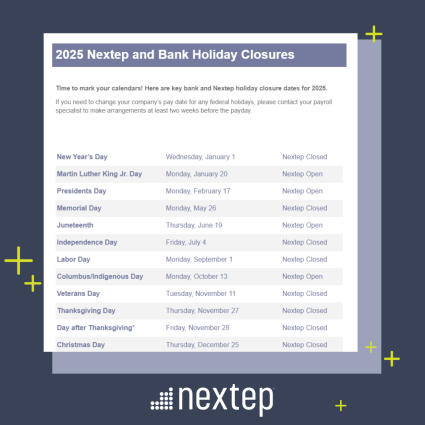
Need a printable copy of the 2025 bank holidays list? Here it is! Download, print, and refer to it at your convenience.
2025 SUTA Wage Bases

We’ve compiled a comprehensive list of 2025 SUTA (State Unemployment Tax Act) wage bases. Find your state in the table and discover the applicable wage base for the upcoming year.